An innovative, cloud native, model-driven content and archiving solution, with a transparent policy-based and attribute-based access control (ABAC), that scales effortlessly with your organization.
Content migration, integration and distribution
Robust, high-performance and secure platform that empowers organizations to distribute content across multiple systems and monitor information flows.
Available for all Documentum user interfaces, AmeXio myInsight is fully certified by OpenText and is a powerful add-on to help you generate custom dashboards and reports in a wide variety of formats.
AmeXio Cloud provides a multi-cloud IaaS, DaaS, PaaS and SaaS offering on 3 levels (public, private and hybrid), which is fully hosted and operated in the EU.
Stop thinking of document management as an app. Start seeing it as a strategy.
For decades, document management was seen as a kind of standalone application: a single platform deployed by IT to store, search, and retrieve files. It was the era of the “monolithic platform to rule them all,” packed with modules and add-ons for every imaginable need: collaboration, retention, records management, DAM, SAP integration… you name it. All vendors promised a Swiss Army knife of document management; but in reality, these platforms rarely delivered the agility organizations demanded.
Today, that model no longer fits the digital reality. The way we create, share, and govern content has evolved, and so must the systems behind it. Many organizations are moving away from the ‘one-app-fits-all’ mindset, recognizing that, for example, short-term collaboration and long-term archiving are fundamentally different disciplines. Trying to force them into a single platform only breeds complexity, compromise, and inefficiency.
That’s why we see that in recent years document management has evolved into a strategic domain, underpinning different use cases with specialized platforms. For IT leaders and information managers, this shift presents both a challenge and an opportunity: to move from managing a monolithic platform to orchestrating a network of specialized capabilities that together support the full lifecycle of content
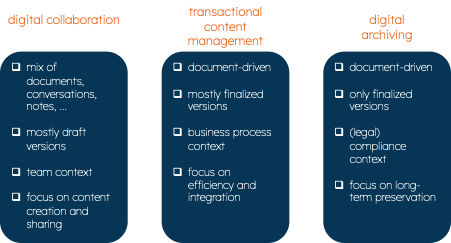
In our view, the document management domain now spans at least three interdependent subdomains:
digital collaboration,
transactional content management, and
digital archiving.
Let’s take a closer look at each of these subdomains.
Digital collaboration – Getting things done
Digital collaboration is about empowering knowledge workers and teams to create, share, and innovate together. Modern work is fast-paced, collaborative, and increasingly hybrid. Projects unfold across borders and time zones, demanding secure information sharing both inside and outside the organization. Employees therfore expect seamless access to content, real-time co-authoring, and integration with the tools they use every day.
For IT, the challenge is to deliver this flexibility without sacrificing security. The goal is to make governance invisible, to embed it in the experience rather than enforce it from the sidelines.
Strategic priorities:
Unified collaboration environments combining documents, chats, notes, and tasks
Governance over sharing and access that protects without slowing people down
Native support for hybrid and remote work models
It’s no surprise that Microsoft 365 has emerged as the de facto standard in this space, blending productivity, collaboration, and governance into a single, connected experience.
Transactional content management – Supporting processes at scale
The subdomain of transactional content management may be less familiar, yet it plays a critical role in many large organizations. These platforms serve as ultra-scalable, back-end repositories that power core business processes in systems such as ERP, CRM, and HR. Think invoices, contracts, HR files, the content that keeps organizations running every day.
Managing transactional content requires more than secure storage: it demands automation, metadata governance, and seamless integration with enterprise systems like SAP, Salesforce, and SuccessFactors. End users rarely interact with these repositories directly; instead, the right information (say, a specific invoice) appears automatically in their business application of choice (e.g. SAP).
Strategic priorities:
Intelligent capture, classification, and routing of documents
Deep integration with enterprise platforms
High scalability, performance, and cost efficiency
Full auditability and traceability of content flows
Leading platforms such as ContentGrid, SER Doxis, and OpenText Extended ECM (xECM) exemplify this domain, combining massive scalability with out-of-the-box integrations for enterprise ecosystems.
Digital archiving – Ensuring legal compliance
Driven by new regulations such as eIDAS 2.0, digital archiving is entering a new era. Long-term archiving is no longer about simply storing old files, it’s about preserving integrity, authenticity, and legal defensibility over time. Organizations must ensure that digital records remain trustworthy and accessible for years, even decades.
This requires specialized platforms that manage digital signatures, timestamps, and retention schedules according to regional and industry standards. While these platforms must scale to manage vast amounts of data, performance is often less critical than reliability and compliance.
A good example of a dedicated digital archiving platform is OpenText Information Archive. It’s worth noting, however, that the archiving landscape is in flux. As EU member states finalize their eIDAS 2.0 implementations, several providers are waiting for certification, a gap that will likely open the door for new players to enter the market by 2026.
So, do you really need multiple document management platforms?
In short, it depends. Smaller organizations with limited transactional or regulatory needs may find a comprehensive digital collaboration platform, such as Microsoft 365, sufficient for now.
However, for most enterprises, a single “jack-of-all-trades” platform often turns out to be a master of none leading to inefficiencies and compliance risks. With growing regulatory pressure and rising expectations around data integrity, we expect that pairing digital collaboration with long-term digital archiving will very soon be the minimal baseline for a modern document management strategy. For larger organizations, transactional content management remains a critical enabler, ensuring that core business processes run efficiently, securely, and at scale. Together, these 3 subdomains therefore form the backbone of a future-ready document management ecosystem.