An innovative, cloud native, model-driven content and archiving solution, with a transparent policy-based and attribute-based access control (ABAC), that scales effortlessly with your organization.
Content migration, integration and distribution
Robust, high-performance and secure platform that empowers organizations to distribute content across multiple systems and monitor information flows.
Available for all Documentum user interfaces, AmeXio myInsight is fully certified by OpenText and is a powerful add-on to help you generate custom dashboards and reports in a wide variety of formats.
AmeXio Cloud provides a multi-cloud IaaS, DaaS, PaaS and SaaS offering on 3 levels (public, private and hybrid), which is fully hosted and operated in the EU.
What one citizen’s digital journey reveals about the future of government
author: Berthold Ballet
4–6 minutes
Meet Marie. She is 48, she has just bought an apartment with her partner, and on a Tuesday evening she finally gets around to arranging life insurance.
She finds your website, likes the quote and starts the application. Twenty minutes later she has photographed her ID card three times because the first two were blurry, gone looking for a proof of address that nobody has received on paper since 2019, and landed on a screen promising that someone will review her file within two working days.
Marie closes the tab. Marie is not coming back.
Hold that thought, because in roughly sixteen months that Tuesday evening is going to look very different, and the reason is a regulation with an unpromising name.
Why information management in government is harder than it looks
Ask most public IT teams where a citizen’s file actually lives and you get a pause, not an answer. Plenty of Flemish public bodies live today with a structural non-conformity they can feel themselves, but haven’t tackled as one problem. Documents sit scattered without governance, without a retention policy, without qualified archiving. Some of it sits in a cloud platform. Some sits in a specialised case-management tool bought a decade ago. Some sits in a legacy system nobody wants to touch because nobody fully understands it anymore.
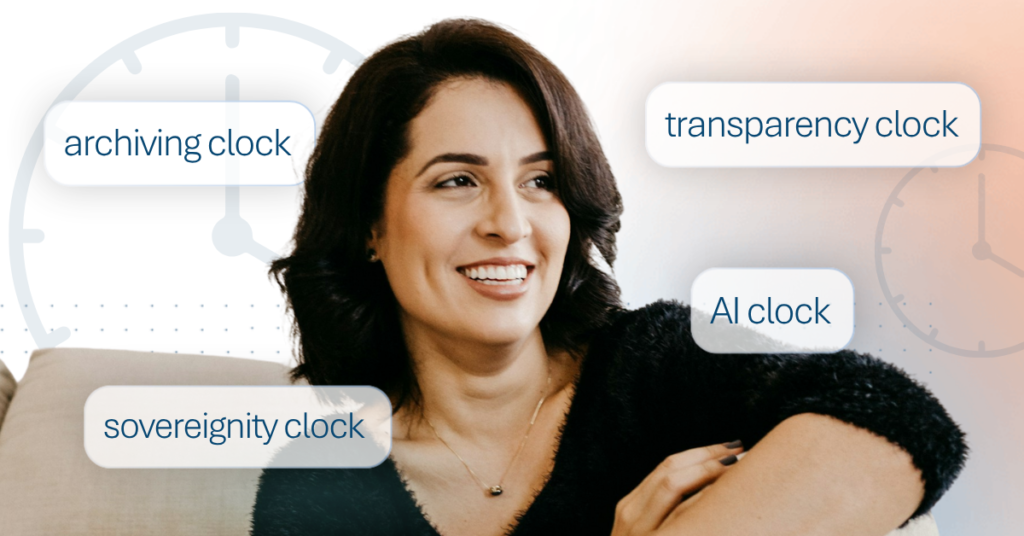
At the same time, the digital government landscape is changing fast, and public organisations face growing regulatory and strategic pressure. There are, in effect, 4 clocks ticking on the same organisation at once, and they all touch the same thing: information.
The 4 clocks ticking at once
The AI clock. AI is moving from experiments into real processes and decisions. An assistant that helps Sophie decide which documents to submit sounds simple enough. But what information does it use to get there? Is it current? And once AI is part of the actual decision, who stays accountable? The European AI Act, for what it’s worth, already requires public bodies to be in order the moment they deploy AI.
The transparency clock. Citizens expect digital access as the default today, not the exception. That raises the bar on what has to be findable, explainable and available. In Flanders, the Bestuursdecreet is the key legal framework for openness of government, and it states explicitly that public bodies must keep their information in good, organised and accessible order, and destroy what qualifies for destruction.
The archiving clock. Digital information can become official evidence. With eIDAS 2 tightening the framework for trusted digital services and electronic documents, information has to stay authentic, reliable, secure and accessible through its entire mandatory lifecycle, not just sit stored somewhere in a system.
The sovereignty clock. Vendor lock-in is no longer a hypothetical. If access to a critical cloud platform is suspended, or a supplier changes its terms, can the organisation still read and use its own information? For a growing number of public bodies, the honest answer is “we’re not sure.”
None of these 4 clocks ticks on its own. AI needs information to work with. Digital services need accessible information. A legally valid archive needs that same information under control from the moment it’s created. And digital sovereignty ultimately depends on controlling information across the whole organisation. Pull on 1 corner of the sheet and the other 3 move with it.
Information management without the headaches, applied to a real case
Most organisations tackle these 4 clocks as 4 separate projects: an AI pilot here, an archiving upgrade there, a new citizen portal somewhere else, a cloud migration on a different timeline again. Each project solves its own piece, and immediately creates a new gap with the next one.
The alternative isn’t a bigger platform. It’s treating these 4 clocks as 1 underlying question: do we actually control our information, end to end, regardless of which system or vendor it happens to sit in this year?
Answer that once, properly, and the 4 clocks stop being 4 separate fires.
AI governance and trusted AI is what makes that AI assistant defensible. Not whether the organisation can deploy AI (it already has, somewhere, whether IT signed off or not), but whether it can trace what information the AI used, who stays accountable for the advice, and how a wrong answer gets noticed and corrected.
Digital citizen portals and services is where Sophie meets the government organisation. She shouldn’t need to understand the backend to know what her next step is. The goal is to make the complexity of government invisible to her, not to digitise the existing bureaucracy and call it done.
Qualified electronic archiving protects Sophie’s file after the decision is made. Not simple storage, but preserving the authenticity, integrity and legal validity a record needs when it’s pulled up years later for an audit, a legal dispute, or a citizen asking to see her own file again.
Sovereign information management happens under the hood. Not “where is the data hosted” but “who controls access to it, and can we still use it tomorrow if the platform it depends on falls away.” That’s a harder question than a data residency checkbox, but it’s the one that actually matters.
Most organisations only discover which of the 4 they’re missing when something goes wrong: an AI recommendation that can’t be explained to an audit body, or a 7-year-old file whose authenticity can no longer be proven. The public organisations asking the question already, before Trefdag, before the next audit, are the ones who get to answer it on their own terms.
Bring your hard information question to the AMEXIO stand at Trefdag Vlaanderen Digitaal.
We’ll tell you honestly whether it’s a quick fix or a real project, and where to start either way.
Sophie gets her decision. She closes the tab and gets on with her renovation. She’ll never know about the 4 clocks that had to run in sync behind that one screen, and if the organisation did its job well, she doesn’t need to.