An innovative, cloud native, model-driven content and archiving solution, with a transparent policy-based and attribute-based access control (ABAC), that scales effortlessly with your organization.
Content migration, integration and distribution
Robust, high-performance and secure platform that empowers organizations to distribute content across multiple systems and monitor information flows.
Available for all Documentum user interfaces, AmeXio myInsight is fully certified by OpenText and is a powerful add-on to help you generate custom dashboards and reports in a wide variety of formats.
AmeXio Cloud provides a multi-cloud IaaS, DaaS, PaaS and SaaS offering on 3 levels (public, private and hybrid), which is fully hosted and operated in the EU.
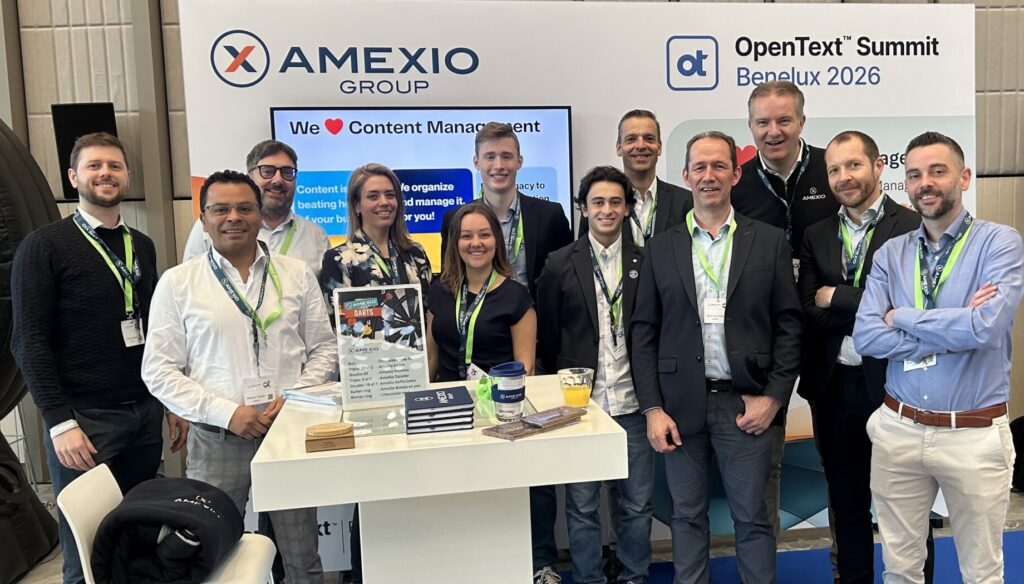
Our message this year was We ❤️ Content Management, because content is the beating heart of every organization. When managed intelligently, content can be transformed into valuable information.
The goal? To share as much valuable knowledge as possible through meaningful conversations and insightful sessions. Once again, we had the pleasure of seeing many familiar faces as well as new ones. In this blog, we’ll walk you through the highlights of the event and share the key insights that matter for organizations working with OpenText solutions.
OpenText highlights you shouldn’t miss
During the OpenText Summit, one thing became very clear: AI is everywhere. What OpenText did particularly well was not just talking about the AI hype, but sharing real insights on how organizations can use AI in a practical and responsible way within their information environments.
We focused specifically on organizations working with enterprise content and digital experiences, where several clear takeaways emerged.
AI only works with the right foundation
The day started with several strategic keynotes, including one by Lars Drexler, explaining how OpenText aims to transform AI from hype into practical enterprise applications.
The message was clear: AI can only deliver value when it is powered by reliable, well-managed information.
An interesting contribution came from the Canadian ambassador, who explained how the Canadian government is implementing AI initiatives within a controlled, on-premise environment.
One important lesson from their experience: the first AI results were far from perfect. But through continuous iteration and by training AI with better data, the outcomes quickly became significantly more accurate, reliable, and usable.
For many organizations this sounds familiar: successful AI implementation is not a one-time project, but an ongoing learning process that strongly depends on data quality and governance.
From unstructured data to valuable and reliable information
One of the most engaging demos was presented by Maarten Raeymaekers, who showed how Knowledge Discovery helps organizations extract valuable information from scattered and uncontrolled data sources.
During his presentation, including a literal “jump into action” on stage, he demonstrated how Knowledge Discovery can analyze, enrich, and structure data from multiple sources. The goal: turning uncontrolled information into secure, usable knowledge.
The process roughly consists of three steps:
Collecting content from various and often unvalidated sources
Enriching and classifying information using AI and metadata
Making knowledge available in a secure, managed environment
Once that foundation is in place, AI can truly deliver value. Tools like Aviator can then analyze and query this enriched content, helping users extract insights from large volumes of enterprise information much faster.
AI-driven content and document experiences
In addition to content intelligence, Digital Experience (DX) was another key theme.
In one of the sessions, it was demonstrated how AI combined with business rules can be used to dynamically generate or adapt documents.
By adding additional business rules, a system can automatically generate new text, context, or information within documents, depending on factors such as customer data, regulations, or process steps.
These kinds of applications show how AI not only helps analyze information but also automates and personalizes communication and document processes. Something that can directly impact efficiency and customer experience for many organizations.
AI, AI and even more AI – AmeXio’s role in modern information management
As mentioned earlier, AI is the topic everyone is talking about right now, including at the OpenText Summit.
However, AI stories are often still quite abstract. That’s why this year we decided to focus on two very concrete AI topics:
OpenText Aviator vs Knowledge Discovery
Building Custom UI and Portals at high speed using AI
Content Aviator vs Knowledge Discovery
The key question is: do you want guaranteed results or intelligent answers? Or a combination of both?
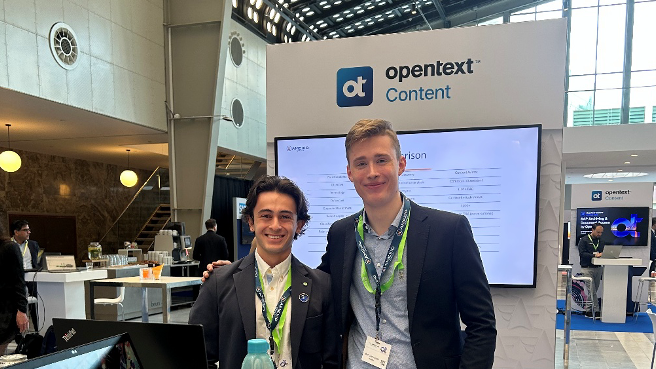
Our own experts Mees Goudman and Bart Dalhuijsen explored this question in more detail during the summit.
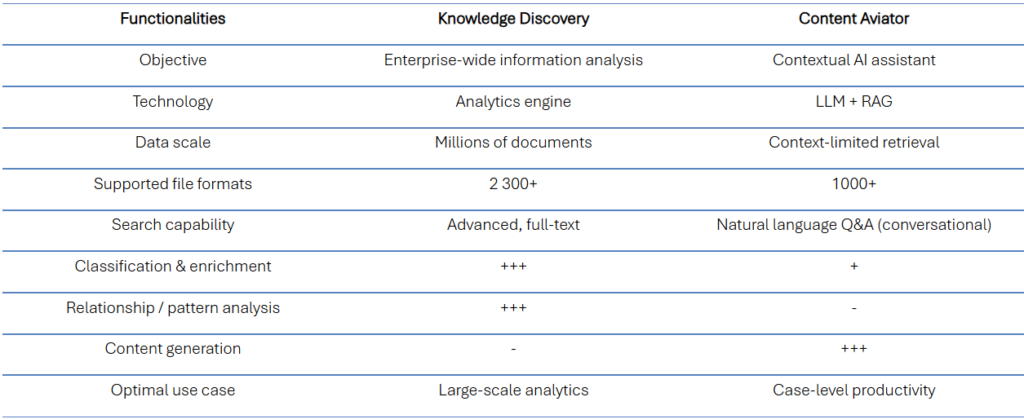
While Knowledge Discovery, a standalone OpenText platform, can search and connect to hundreds of databases to make information sustainable and structured, Aviator focuses on generating insights and integrating that information into workflows.
Knowledge Discovery use cases
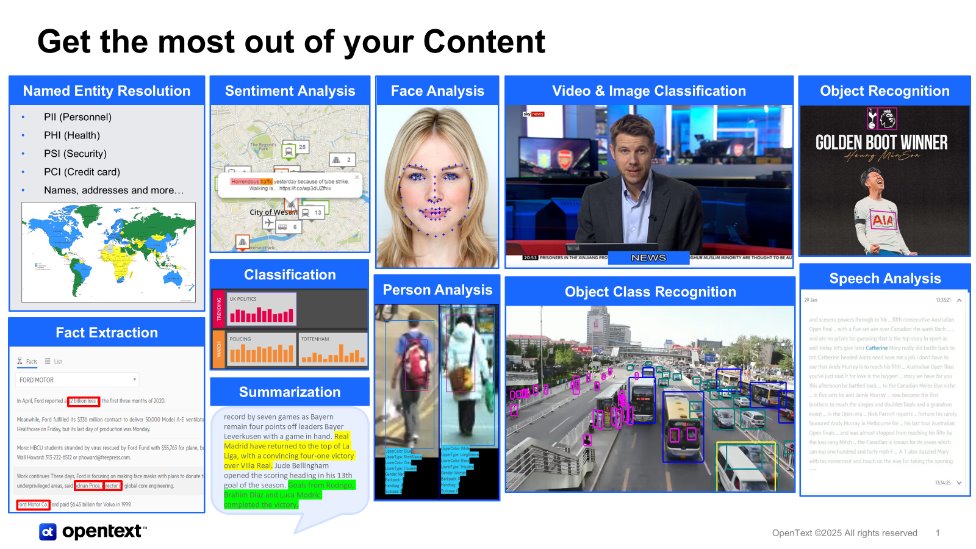
With Knowledge Discovery you can:
Recognize and connect identities such as people, organizations, or locations across different data sources
Automatically detect sentiment in text (positive, negative, or neutral)
Recognize and analyze faces in images or video
Classify images and videos based on their content
Identify objects in images or video
Extract key facts and important information from documents
Categorize content into document types or topics
Summarize documents
Identify and analyze personal information within content
Recognize objects in images and assign them to specific categories
Analyze spoken language and convert it into text or insights
Content Aviator use cases
Content Aviator is an AI assistant that uses GenAI to:
Generate document summaries extremely quickly
Provide accurate answers including references
Use semantic search that understands the intent behind queries instead of relying on keywords
Compare documents and highlight differences
Draft emails based on your organization’s own data
Generate tables, diagrams, and other visual content based on your data
Now that we understand the use cases of both Knowledge Discovery and Content Aviator, how does the comparison look in practice?
In the 26.4 release (later this year), Aviator Studio will be introduced, enabling organizations to build their own agents. Within this environment, Knowledge Discovery can be connected to Content Aviator through Aviator Studio.
This allows Knowledge Discovery to structure and enrich the information, while Content Aviator generates insights from it or integrates it into workflows.
Mees and Bart on their Experience
Custom UI and portals built with AI
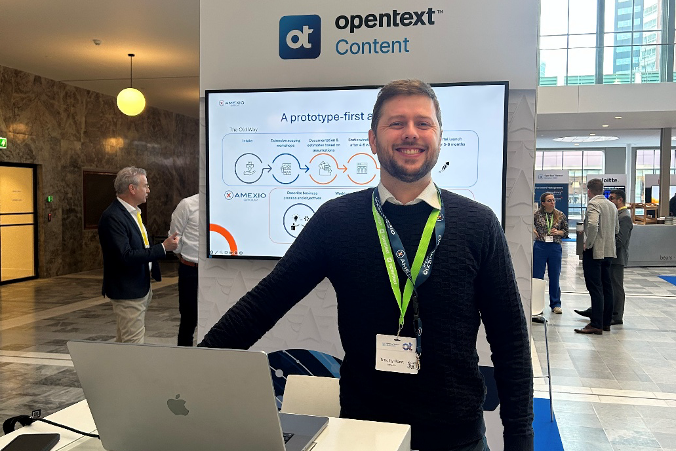
Another demo showed how organizations can accelerate the development of operational portals by combining AI with a prototype-first approach. This was demonstrated by our expert Timothy Baert at one of the Experience Pods.
Many organizations struggle with fragmented information, complex interfaces, and users constantly switching between different systems.
During the session, it was demonstrated how a unified portal layer can bring multiple ECM platforms, such as SharePoint, Alfresco, and Documentum, together into one role-based interface. This makes information easier to access and improves the efficiency of daily processes.
One key takeaway was the shift toward a prototype-first approach.
Instead of spending weeks defining interfaces before users even see them, AI agents make it possible to generate working portal prototypes within hours. This allows ideas to be tested immediately, feedback to be gathered early, and iterations to happen much faster.
By starting with a focused use case, such as operator dashboards, compliance workflows, or manager approvals, organizations can launch their first portal application within just a few weeks and then gradually expand it across the organization.
The result: faster implementation, a better user experience, and a scalable portal strategy for the entire enterprise landscape.
Inspirational speaker: Sander de Kramer on his work in Sierra Leone
In addition to technology, there was also room for inspiration.
To close the day, Sander de Kramer, Dutch journalist, television presenter, and human rights activist, delivered an inspiring presentation that deeply impressed the audience.
With humor and powerful storytelling, he shared stories about the lives of homeless people in Rotterdam, the Homeless World Cup, Chief Ouwe Dibbes, and his work in Sierra Leone, where he is committed to improving living conditions and education for children.
His story reminded the audience that technology ultimately exists to create impact for people and society.
For those interested in learning more about his work, the book Chief Ouwe Dibbes is highly recommended. Those who wish to contribute can support the Sunday Foundation, which funds projects that improve the lives of children in Sierra Leone.
What’s Next?
Did you miss the OpenText Summit? Or were you there and want to explore certain topics in more detail?
We would love to continue the conversation with you.